Beedier Social Media Zeitgeist – the first facts and figures
Some initial statistics from the first major review of social media performance for architecture studios in the United Kingdom and Ireland.
If you are a subscriber to Beedier, then you have probably already reviewed the first published chart of social media performance for UK and Irish architectural companies. Subscribe here if you haven’t already.
Aside from the interest gained from finding out where you are in the list, there are some valuable statistics that can be gleamed about social media usage across the industry as a whole. We present here the first set of statistics and observations…
We have accounted for more than 7000 architectural companies in the UK and Ireland, and have found that nearly 5,000 of them use social media accounts in some way to promote themselves.
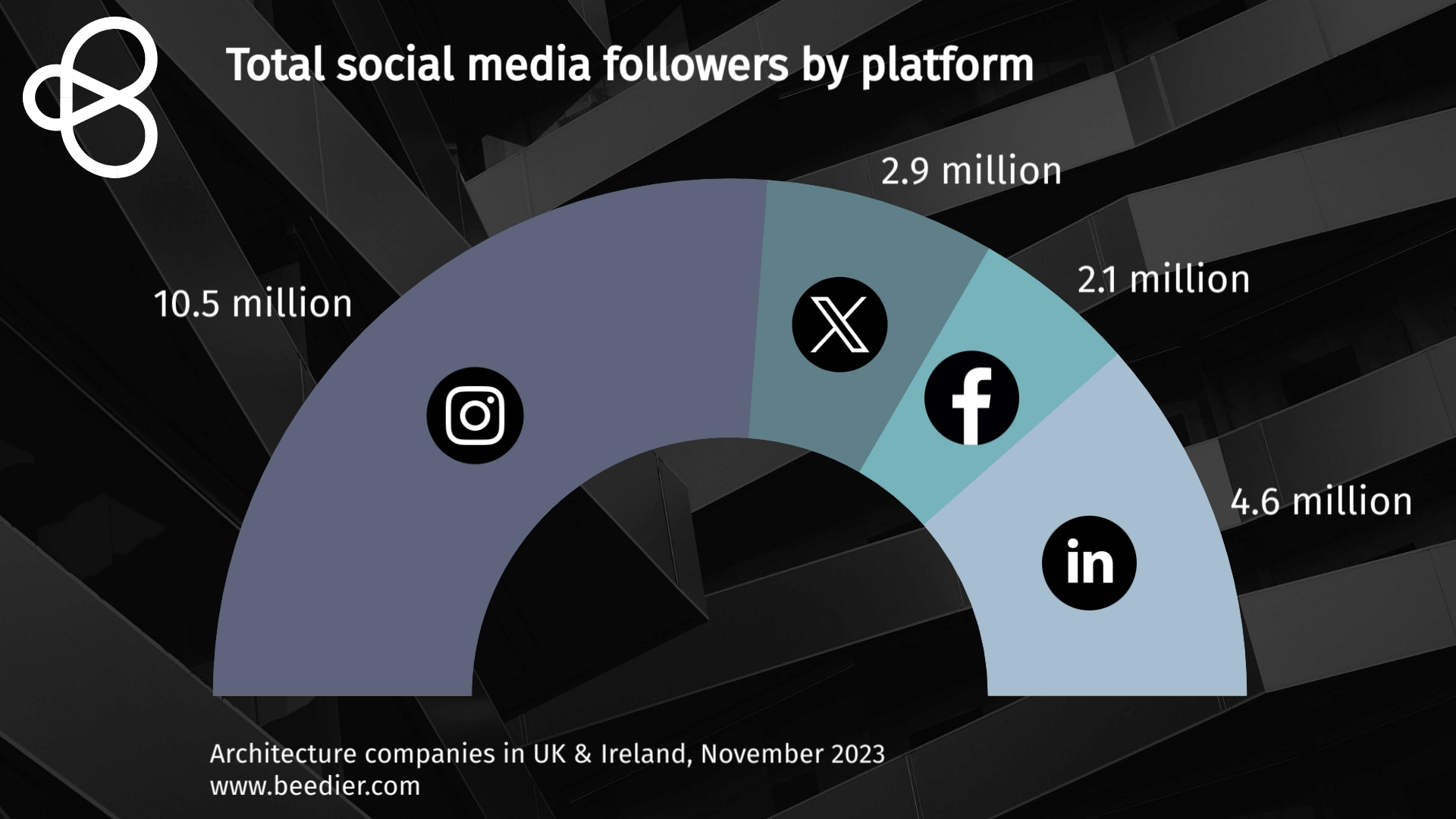
Architects in the UK and Ireland collectively have 20.1 million followers, across the four most widely used social media platforms, Instagram, X, Facebook and LinkedIn. Of course, these followers are not unique, as many people will follow multiple pages.
Instagram is the most followed social media platform within the sector, accounting for more than half of all followers.
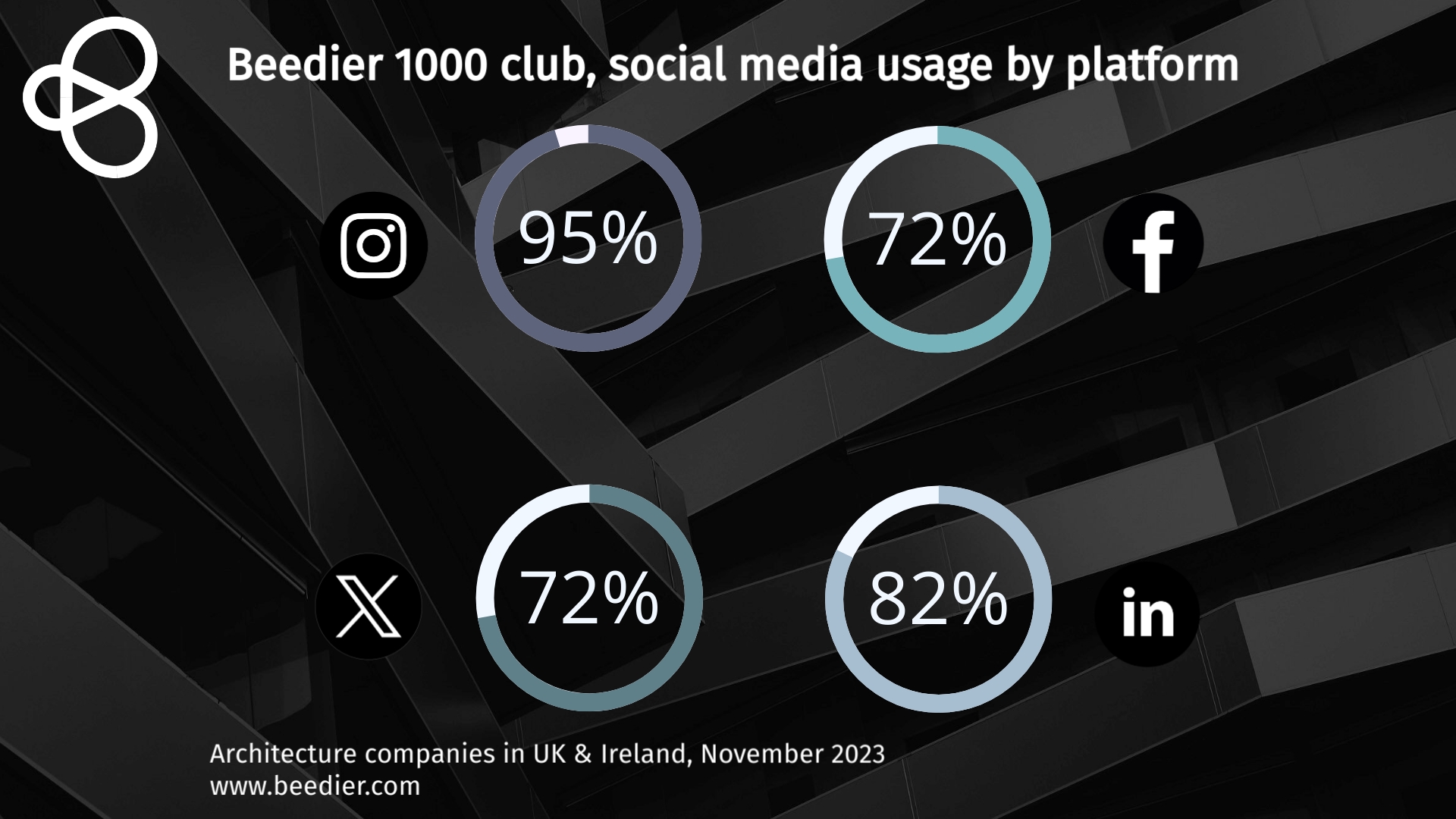
Of all the companies that have more than 1,000 followers, “The Beedier 1000 Club”, 95% of them have Instagram accounts, with an average of 4,400 followers per account.
The top ten placed companies on the list account for 28% of all follower counts, with 5.9 million followers between them.
Companies with headquarters in London have a total of 13.3 million followers, 65% of the total follower count. 31% all architectural practices on our list are based in London.
The number one company on the list has a total follower count of 3 million users – who is it? You’ll have to subscribe to find out!
The statistics in detail
Firstly, let’s look at each platform and gauge which is used mostly widely to follow architecture.
Instagram is by far the most followed, and also the platform where it is most easy to engage new followers – architecture lends itself as a visual medium – and the gallery-like aspects of Instagram conveniently act as a showcase portfolio that is appealing to engage with.
LinkedIn company pages are the next most followed, perhaps because it is the nature of the platform to engage with business related feeds, and connect with collaborators. But which social media platforms are growing followers, and which are losing followers? As new data comes in every quarter, we will provide an accurate picture of the state of play.
Nearly half of the architectural companies that we have tracked have more than 1,000 followers across all of their accounts. We refer to this, affectionately, as The Beedier 1000 Club. If we just look at these companies, organisations of different sizes from sole practitioners to large established firms – all managing successful social media accounts – again, we can see a greater prevalence in the use of Instagram, but still a large take-up of the other three platforms, LinkedIn, X and Facebook.
Our research has informed us that these are by far the most common social medial platforms for architects, although others are also used to a lesser extent – including Pinterest, YouTube, Behance and Houzz. We have also noticed some companies that have introduced Threads accounts – and even spotted some links to defunct Google+ pages. Please update your websites!
Regional spread of social media followers
Across the regions, there is a major slant towards the social media accounts of companies based in London and the South East. Unsurprisingly perhaps, as many of the most followed architecture studios have their main office in the capital, and nearly a third of all architecture companies in the UK and Ireland are headquartered London.
In addition, the most well known architects – often large practices with overseas portfolios – also based in London, and are more likely to have an international following.
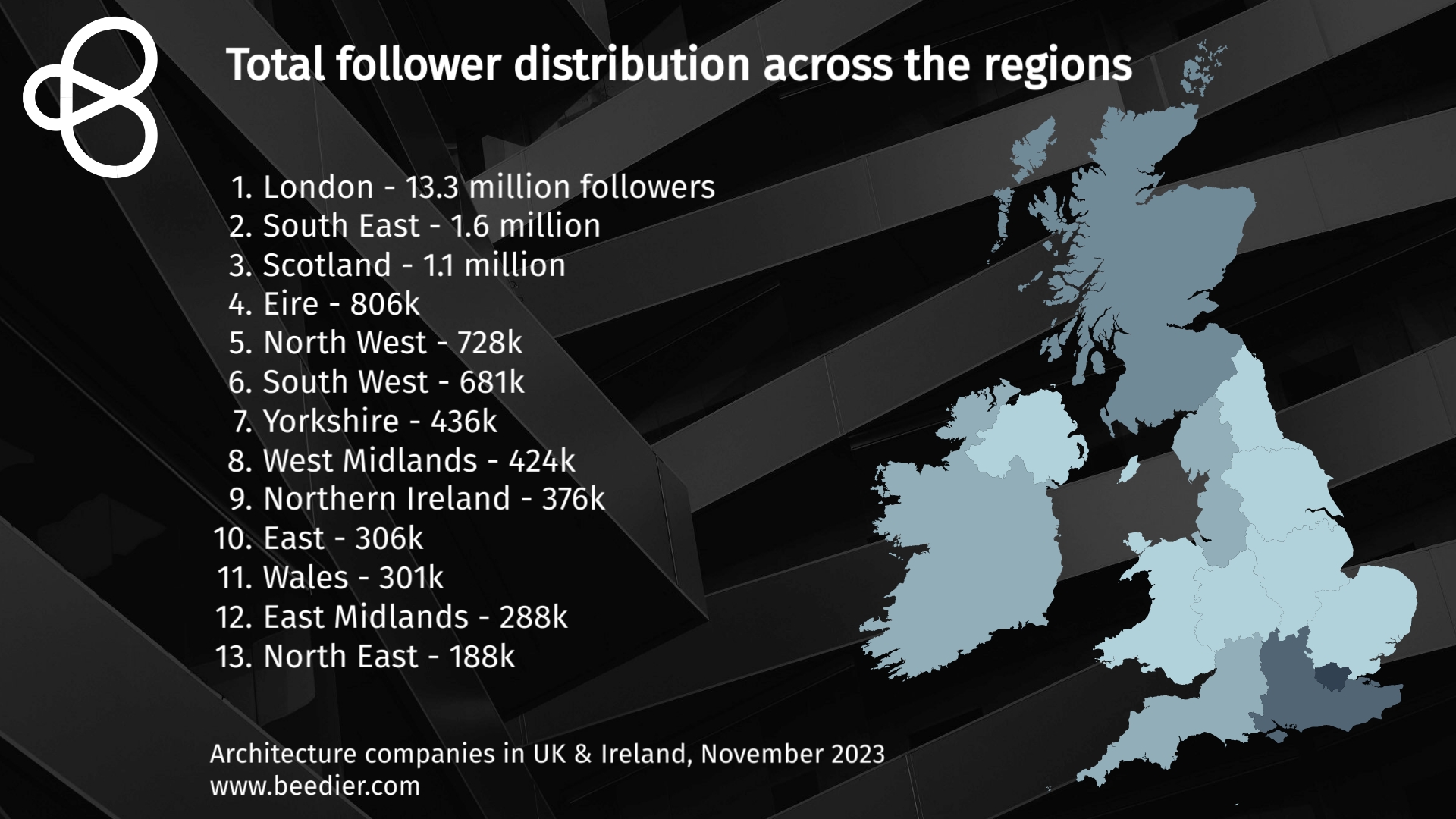
Excluding London, we can still see that there is a widespread interest and following of architectural social media pages across the regions. We can also see that in the same way that London dominates the overall picture, Dublin also accounts for the majority of all followers in the Republic of Ireland (74%) – likewise Belfast in Northern Ireland (65%). In Scotland, Edinburgh and Glasgow account for 70% of all social followers in the sector.
It is also noticeable, that some small towns are quite high up the list, and this is largely due to the influence of successful singular practices who happen to be headquartered away from the usual major cities.
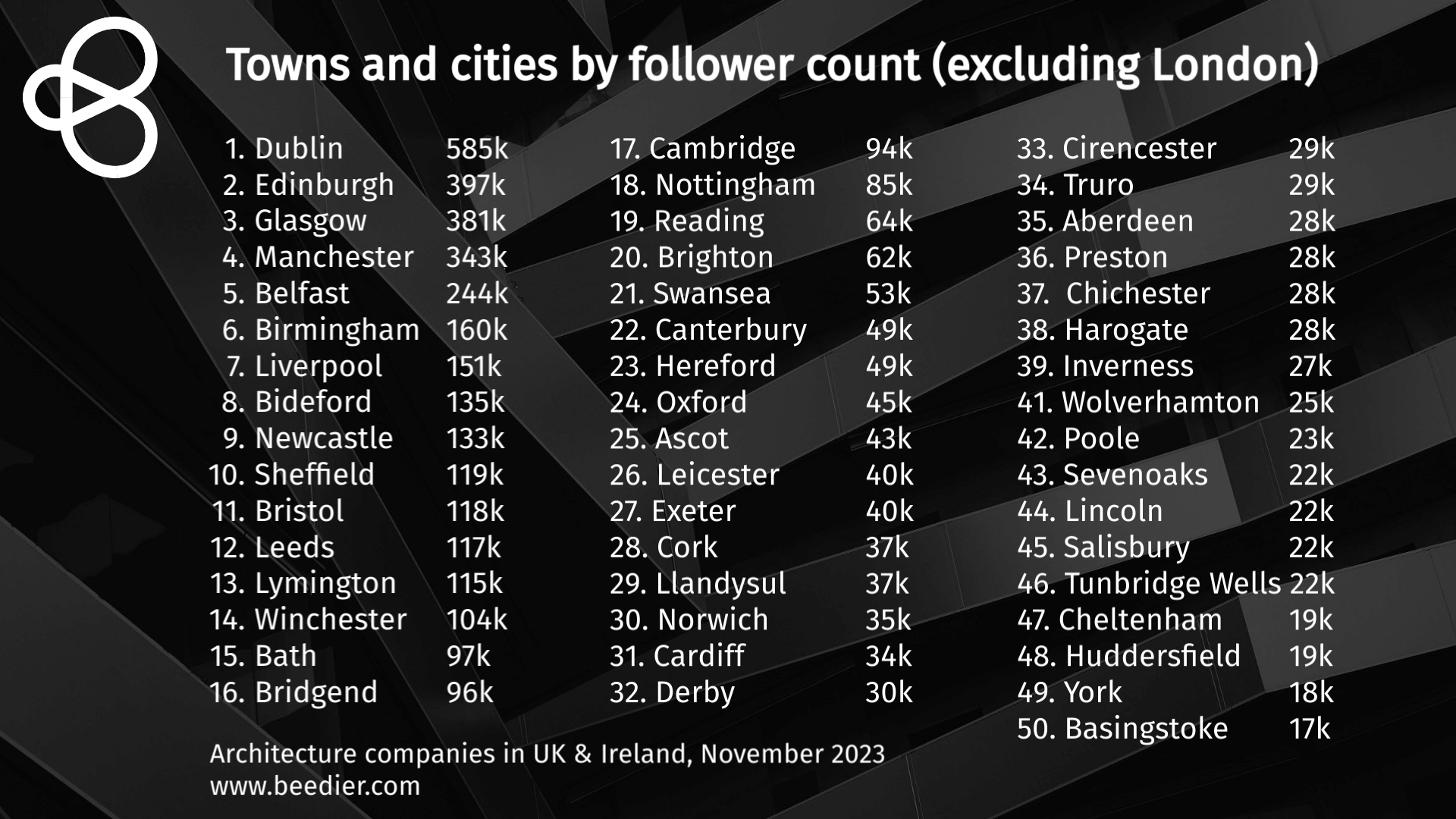
Beedier will continue to interrogate the stats, and bring forward other engaging and useful insights over time.
Advertisements